
.JPG)

When Typhoon Yolanda left the country, it left a trail of devastation. It swept away loved ones, homes and the source of income of many Filipinos, especially in hard hit areas of Leyte and Samar. Despite the vast amounts and different kinds of international and local aid given, the national government’s reaction has been slow. Now, three months after the disaster, not much has changed.
Barangay Canlampay, for example, is a farming community in Carigara, Leyte. According to Guillermo Panal, Canlampay’s Barangay Captain, when Typhoon Yolanda struck, 95% of the homes were totally damaged, brought down by a combination of strong winds and weak construction materials. Their sources of income were affected as well, with the winds damaging and uprooting the coconut trees and the floods engulfing their fields.
Today, the community is still dependent on relief goods for food. There is no clear rehabilitation plan or action from the higher government. All they have received are 10 blankets and tarpaulins for the whole barangay of 903 individuals. They still await when promises of gaining electricity and the rehabilitation of the coconut trees would be fulfilled.
Delia Darantinaw, president of the Municipal Farmers’ Association of Carigara (MUFAC), is critical of the situation.
“It would have been more difficult for us to recover from the tragedy if we depended on the national government alone. Our association has taken the lead in rebuilding what we had lost. Through empowering the community, pushing them in taking an active role in planning and implementation of programs, and reaching out to non-government organizations for support”, she stated.
The MUFAC is busy trying to implement their irrigation and vegetable garden programs to help the community produce their own food again. Preparation of the plains is in progress. Fast growing vegetables, such as gabi or taro and sweet potato, are encouraged to be grown in home gardens to help the community get by without having to eat only relief goods.
Helping out each other is what the organization stresses, especially in times of disaster.
However, Darantinaw said they need farming tools, animals and seeds. They have repeatedly asked the local government of Carigara for assistance but the municipality has yet to heed their requests for these. They appealed to organizations and individuals to help them get back on their feet through supporting their sustainable agriculture rehabilitation plans.
Thursday, January 23, 2014

Thursday, January 9, 2014
DOH’s Poor Handling of Measles Outbreak: Telling Signs of Looming Health Disaster to Come in Typhoon Ravaged Areas of Leyte and Samar
“The recent measles outbreak and the government’s poor response in containing it appeared to be a very fearful precedent of other possible health disasters in typhoon ravaged areas of Leyte and Samar”, said Samahang Operasyong Sagip (SOS) President Rosalinda C. Tablang.
The year 2013 ended with a sharp increase in the number of measles cases, especially in Metro Manila. Of the 1,724 confirmed cases, 744 were recorded in the metropolitan region. Outbreaks have already been announced by the Department of Health (DOH) in 9 cities of Metro Manila, namely Manila, Caloocan, Las Piñas, Malabon, Muntinlupa, Navotas, Parañaque, Taguig and Valenzuela.
The DOH has blamed the poor access of health services in poverty-stricken areas, unwillingness of parents in vaccinating their children and the influx of people from typhoon hit areas of Leyte and Samar to the recent outbreak.
Tablang shared that the DOH has the mandate to abate, control and monitor public health. The DOH implemented the foreign-assisted ten-year “Alis Tigdas” Program from 1990 to 2008. But in 2007, the DOH already admitted that it failed to reach one hundred percent target to immunize children against measles. In July 2011, it re-launched another anti-measles program “Iligtas ang Pinas Sa Tigdas” aiming again towards measles eradication.
“One would ask, what have the government decisively done with the measles problem if they have known the problem as early as 2007? The past anti-measles programs were just all hype and relied heavily on an approach that is immunization-focused. Health education and information are lacking,” furthered Tablang
“Instead of owning up to its failure, the DOH has been quick to blame the patients and their parents, and even the very victims of Typhoon Yolanda for the recent outbreak. This is telling of how the DOH will react to other threats of health disasters, such as what we are seeing now in Leyte and Samar”, added Tablang.
The SOS has been conducting medical missions and relief distribution operations since November 2013. Ailments observed in patients from the first medical mission up to the most recent have been similar. The most common medical cases in adults include upper respiratory tract infections, acute gastro-enteritis and hypertension and tension headache. For children, these were cough and colds, fever and diarrhea.
Tablang expressed that outbreaks after natural disasters occur when there is a substantial displacement of people. Along with this, poor access to basic needs, such as safe potable water, proper sanitation, adequate shelter and health care services, play a role in increasing disease transmission.
“More than 2 months after the typhoon struck, scarcity of necessities, such as food, potable water and shelter, still pose as an everyday problem. With the DOH poorly handling the measles outbreak, especially in Metro Manila where there are relatively more health centers and hospitals, we can only imagine how it will be for those in Leyte and Samar.” ##
Monday, January 6, 2014
SOS Continues Typhoon Yolanda Response
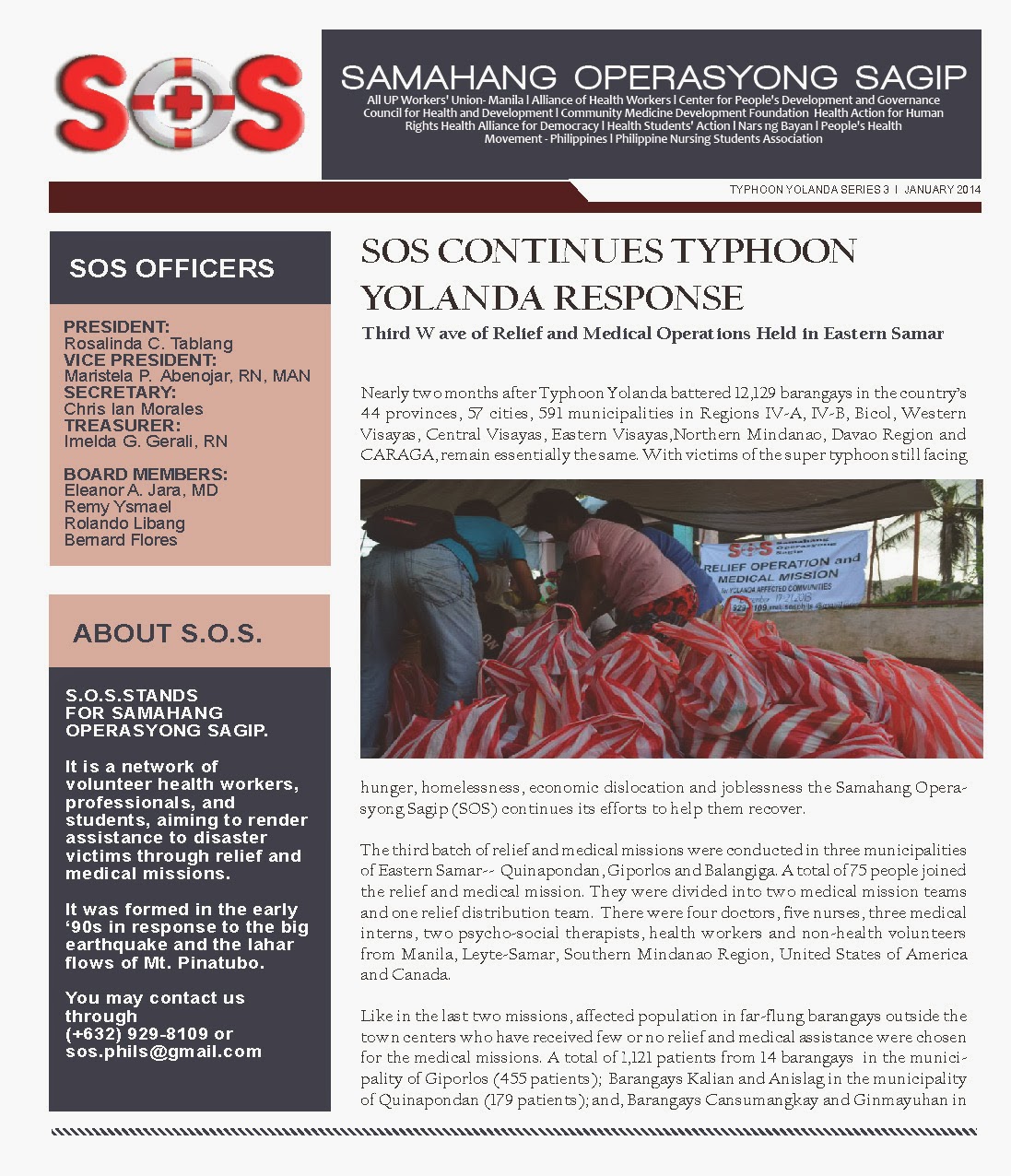
You may read the SOS Newsletter Issue 3 here or
or download it here
Nearly two months after Typhoon Yolanda battered 12,129
barangays in the country’s 44 provinces, 57 cities, 591 municipalities in
Regions IV-A, IV-B, Bicol, Western Visayas, Central Visayas, Eastern
Visayas,Northern Mindanao, Davao Region and CARAGA, remain essentially the
same. With victims of the super typhoon still facing Nearly two months after
Typhoon Yolanda battered 12,129 barangays in the country’s 44 provinces, 57
cities, 591 municipalities in Regions IV-A, IV-B, Bicol, Western Visayas,
Central Visayas, Eastern Visayas,Northern Mindanao, Davao Region and CARAGA,
remain essentially the same. With victims of the super typhoon still facing
hunger, homelessness, economic dislocation and joblessness the Samahang
Operasyong Sagip (SOS) continues its efforts to help them recover.
The third batch of relief and medical missions were
conducted in three municipalities of Eastern Samar-- Quinapondan, Giporlos and
Balangiga. A total of 75 people joined the relief and medical mission. They
were divided into two medical mission teams and one relief distribution team.
There were four doctors, five nurses, three medical interns, two psycho-social
therapists, health workers and non-health volunteers from Manila, Leyte-Samar,
Southern Mindanao Region, United States of America and Canada.
Like in the last two missions, affected population in
far-flung barangays outside the town centers who have received few or no relief
and medical assistance were chosen for the medical missions. A total of 1,121
patients from 14 barangays in the municipality of Giporlos (455 patients);
Barangays Kalian and Anislag in the municipality of Quinapondan (179 patients);
and, Barangays Cansumangkay and Ginmayuhan in the municipality of Balangiga
were served. The most common medical cases included upper respiratory tract
infections, acute gastro-enteritis and hypertension, tension headache among
adults; and fever, diarrhea, cough and colds among children. These ailments
were also observed in the first and second waves of SOS medical missions in Eastern,
Western Samar and Leyte provinces.
Twelve psycho-social therapy sessions among children and
mothers in the selected barangays of Quinapondan, Giporlos and Balangiga were
conducted by the mission team. There were nine therapy sessions for children
and 3 therapy batches for mothers, benefitting a total of 550 children and 150
mothers. The psycho-social team effectively made use of play therapy (for
children and adults), experience sharing and exercise methods (for adults) to
help them process what they have gone through with Typhoon Yolanda. Eleven
individuals were provided psycho-social counseling. The relief drive operations
on the
other hand, benefitted 2,376 families from 13 selected
barangays in the towns of Quinapondan, Giporlos, and Balangiga. They were able
to receive relief packs, clothes, plastic sheets, building materials like
nails, saw, and hammers. The mission team also gave hundreds of Christmas
Goodies Packs for children. Six water filtration pails were given to
representatives of the barangays in the towns of Giporlos and Balangiga.
As in the previous relief and medical missions, health risks
such as the lack of potable water supply, lack of electricity, nails and
pointed objects in debris that could lead to disease outbreaks and accidents
were noted. The number of diagnosed diarrhea cases among children and cases of
acute gastroenteritis among adults proved the risk of a possible disease
outbreak. Most people in affected barangays are trying to rebuild their homes
and lives. Yet many barangays especially those far from town centers are still
in need of assistance, food, supplies, and construction materials. The affected
families shared their hopes that they may be assisted in
repairing/reconstructing their homes and in regaining their lost livelihood
especially in starting up food production and their fishing activity.
People’s participation in planning and actual implementation in relief and
rehabilitation efforts is important to ensure relevance of relief efforts and
medical services. SOS thus maintains and reiterates the following
recommendations:
1. Government’s relief and medical assistance should include
far-flung barangays. Many communities especially those located in the upland
received very little assistance while many shared that they have not received
any assistance at all.
2. There is a great need to provide assistance for people to
rebuild theirhomes and communities, through provision of construction materials
including GI sheets, nails, hammer, saw, etc. The government should reconsider
the Department of Trade and Industry (DTI) program of selling GI sheets that is
beyond the capacity of the affected population.
3. Immediate and comprehensive health interventions to
address potential sources of outbreaks and epidemics. These include immediate
clearing of debris, provision of safe/potable water source, construction of
shelter, provision/ assistance in food production and livelihood.
4. Assistance for livelihood and rehabilitation- livelihood,
food production and economic activities. ##
Monday, December 16, 2013
Third SOS solidarity mission off to Eastern Samar
The third solidarity mission of health disaster group Samahang Operasyon Sagip (SOS) is travelling again to Eastern Samar to reach the upland areas of Quinapondan, Giporlos, and Balangiga in Eastern Samar today, December 17 until the 22nd. These communities very scarcely received relief and medical assistance since the onslaught of typhoon Haiyan.
SOS President Rosalinda C. Tablang announced that for the third wave of relief and medical mission efforts, they will be serving at least 1,500 families in barangays Sto. Niño, Catilian, and Anislag in Quinapondan; barangays Roxas, Huknan, 6, and 7 in Giporlos and; barangays Gimmayuhan, Cansumangkay, and Bunga in Balangiga -- all in Eastern Samar province.
In the midst of all the merry-making and warm heartedness this Yuletide season, Tablang appealed to “kind souls who may find joy in giving.” “Not everybody may have as much in their pockets, but in so many other ways, each one can help,” she added.
“Aside from the family food packs that consist of 8 kilos rice, 5 pieces canned goods, ½ kg sugar, ½ L cooking oil, ½ kg mung beans, ¼ kg salt, ½ kg dried fish, and ½ bar laundry detergent, we are also bringing hygiene kits, plastic sheets, nails, flashlights, candles, and matches,” she said.
Tablang expressed that aside from the relief packs, the communities requested for simple construction materials to enable them to build their modest shelters anew. “We are also bringing some gasoline to power the community chainsaw because the people want to rebuild their bridge in Barangay Huknan that was toppled down by [typhoon] Haiyan,” she noted.
SOS volunteers are also packing donated blankets, personal hygiene kits including sanitary napkins and jerry cans for potable water storage.
For the medical mission, the SOS team is headed by four doctors, including an infectious disease specialist from the United States, and several nurses.
Together with the communities in Leyte and Samar in the Visayas, SOS is untiringly calling for immediate and comprehensive rehabilitation efforts.
The continuous medical and relief missions of SOS are made possible through the kindness of donors, from all ages and all walks of life, here and abroad. SOS is continuing its resource generation drives for the long term rehabilitation of affected communities in Leyte and Samar. For inquiries, please contact Mel, 0947-4535788 or Grace, (+632) 929-8109. They may also be emailed at sos.phils@gmail.com.##
Reference: Rosalinda C. Tablang 0927-9259413 / (+632) 929-8109
President, Samahang Operasyong Sagip (SOS)
Sunday, December 15, 2013
SOS Continues Response to Typhoon Yolanda Aftermath

You may read the SOS Newsletter Issue 2 here or
or download it here
One month after Typhoon Yolanda’s onslaught, the fate of millions is still in limbo. With victims of the super typhoon facing homelessness, joblessness and hunger, the Samahang Operasyong Sagip (SOS) continues its efforts in helping them get back on their feet once more.
The second series of medical missions and relief drive operations were conducted in 9 barangays in the 3 municipalities of Leyte- Albuera, Ormoc and Kananga. A total of 41 individuals, 5 of which were doctors, 11 nurses, 3 medical interns, and health workers and volunteers from Leyte-Samar, Manila, Surigao del Sur, Cebu, and United States of America comprised the medical and relief mission team. They were divided into 2 medical mission teams and 1 relief distribution team.
Families from far-flung areas outside the town centers ,who have received few or no relief assistance and medical mission since the typhoon, were chosen for the medical missions and relief drive operations.
A total of 1,942 patients from Barangays Tinag-an, Antipolo and Mahayag in the Municipality of Albuera; Barangays Lunoy, Sto. Domingo and Natubgan in the Municipality of Kananga; and Barangay Ipil in Ormoc were served. Meanwhile, the relief drive operations benefitted 1,436 families from selected barangays in the towns of Albuera, Ormoc, and Kananga. They were able to receive relief packs, plastic sheets, building materials like nails, saw, hammers, cooking pots, and used clothes. Three water filtration pails were given to representatives of the three towns for use of the communities.
The most common medical cases included upper respiratory tract infections, hypertension, wounds or injuries, skin infections, acute gastro enteritis, diarrheal diseases, tension headache and insomnia. These ailments were also observed in the first wave of SOS medical missions in Eastern and Western Samar. The people in Tinag-an, Albuera requested for psychosocial assistance and tetanus toxoid for wounds sustained during the repairing and rebuilding of their homes.
Major health risks which could lead to serious disease outbreaks were noted. These include the lack of potable water supply, as observed in Barangay Ipil, Ormoc; Lack of adequate and safe shelter and housing; Lack of electricity make night time pitch black and movement in the areas difficult and dangerous; Undernourished children, and; Presence of stagnant water and debris, which are breeding grounds for mosquitoes and other carriers of diseases.
Most people in affected barangays have been trying to rebuild their homes and lives, yet many, especially those far from town centers, are still in dire need of assistance such as food, supplies and construction materials. It is pertinent that they be part of the planning and actual implementation in the relief and rehabilitation efforts so as to ensure relevance of relief efforts and medical services.
We thus recommend the following:
1. Government’s relief and medical assistance should include far-flung barangays.
2. Assistance for people to rebuild their homes and communities, through provision of construction materials including GI sheets, nails, hammer, saw, etc. For sale construction materials promoted by DTI could not be afforded by many especially those whose livelihood was affected.
3. Immediate and comprehensive health interventions to address potential sources of outbreaks and epidemics. These include immediate clearing of debris, provision of a safe water source, construction of shelter, assistance in food production and livelihood.
4. Assistance for livelihood and rehabilitation- provision of construction materials, livelihood, food production, and economic activities. ##
Wednesday, December 11, 2013
Thursday, December 5, 2013
Foreign loan will further bury the nation into the quagmire of debt and poverty
The last thing the Filipino people need right now is to pay-off more debts in the future.
This was Samahang Operasyong Sagip’s (SOS) reaction to reports that the Philippine government plans on incurring new loans from the World Bank (WB) and Asian Development Bank (ADB) amounting to US$1 billion. The two financial institution giants appropriated US$500 million each for the rehabilitation and reconstruction of Typhoon Yolanda (Haiyan) affected areas.
SOS is a disaster management group made up of different health NGOs and advocates.
Latest government estimates say that a successful reconstruction effort in the typhoon’s aftermath can amount to P250 billion (US$5.8 million).
Rosalinda C. Tablang, SOS president, noted that while additional infusion of budget may sound encouraging to some, she reminded the public that what these banks are giving are loans and not grants. “Loans are meant to be paid. And, when a government decides to borrow from lenders such as WB and ADB, it’s the people who will pay later on,” Tablang said.
She further commented that the storm surge and foreign loan have one thing in common – both are catastrophically fatal to the people as this means that Filipinos, including the victims of Typhoon Yolanda will be further burdened in paying the new calamity loan. The Philippine’s foreign debt has reached $60.3 billion at the end of 2012.
SOS also said that the ADB and WB are at the “height of their insensitivity and greed for taking advantage of the recent disaster to rake in more profit through loan interest.” Tablang commented that loans are always with conditionality, “paying off the principal amount plus the interest will mean larger cuts in the national budget for the coming years.” This will translate to smaller allotments for basic social services such as health, education, housing, agricultural subsidy and wage increase among others, she argued.
Instead of loans, SOS asserted that the government “should use foreign grants, local donations, and specific allotments from the national budget to rehabilitate the regions devastated by Yolanda.”
As of this writing, the Foreign Aid and Transparency Hub (FAiTH) website marked a total of PhP4,604,299,695.10 or US$104,968,300 of foreign aid from various international agencies.
On top of these, the government should “increase the national calamity fund in the next year’s appropriation.” Calamity fund for this year was meagerly allotted PhP7.5 billion or a measly .75% of the PhP2.006 trillion 2013 national budget.
Tablang said that the Aquino government should have at least shown a little degree of independence and self reliance.
Instead of entertaining loans from international financial institutions should decisively allocate significant budget for post-Yolanda rehabilitation efforts. Billions of people’s money that are being stashed away to corruption should be spent wisely to help millions of families that were rendered homeless and economically devastated by Typhoon Yolanda.
“Should it sincerely wish to help the people, the Aquino administration can create rehabilitation funds without having to be enslaved by foreign loans that have strings attached to it. If Aquino pushes through with the loans from IMF-WB, he makes it all too obvious, again, that foreign domination through economic control is unforgiving even in the most trying times,” she ended.##
Subscribe to:
Posts (Atom)

 Posts
Posts

