


Wednesday, December 11, 2013

Thursday, December 5, 2013
Foreign loan will further bury the nation into the quagmire of debt and poverty
The last thing the Filipino people need right now is to pay-off more debts in the future.
This was Samahang Operasyong Sagip’s (SOS) reaction to reports that the Philippine government plans on incurring new loans from the World Bank (WB) and Asian Development Bank (ADB) amounting to US$1 billion. The two financial institution giants appropriated US$500 million each for the rehabilitation and reconstruction of Typhoon Yolanda (Haiyan) affected areas.
SOS is a disaster management group made up of different health NGOs and advocates.
Latest government estimates say that a successful reconstruction effort in the typhoon’s aftermath can amount to P250 billion (US$5.8 million).
Rosalinda C. Tablang, SOS president, noted that while additional infusion of budget may sound encouraging to some, she reminded the public that what these banks are giving are loans and not grants. “Loans are meant to be paid. And, when a government decides to borrow from lenders such as WB and ADB, it’s the people who will pay later on,” Tablang said.
She further commented that the storm surge and foreign loan have one thing in common – both are catastrophically fatal to the people as this means that Filipinos, including the victims of Typhoon Yolanda will be further burdened in paying the new calamity loan. The Philippine’s foreign debt has reached $60.3 billion at the end of 2012.
SOS also said that the ADB and WB are at the “height of their insensitivity and greed for taking advantage of the recent disaster to rake in more profit through loan interest.” Tablang commented that loans are always with conditionality, “paying off the principal amount plus the interest will mean larger cuts in the national budget for the coming years.” This will translate to smaller allotments for basic social services such as health, education, housing, agricultural subsidy and wage increase among others, she argued.
Instead of loans, SOS asserted that the government “should use foreign grants, local donations, and specific allotments from the national budget to rehabilitate the regions devastated by Yolanda.”
As of this writing, the Foreign Aid and Transparency Hub (FAiTH) website marked a total of PhP4,604,299,695.10 or US$104,968,300 of foreign aid from various international agencies.
On top of these, the government should “increase the national calamity fund in the next year’s appropriation.” Calamity fund for this year was meagerly allotted PhP7.5 billion or a measly .75% of the PhP2.006 trillion 2013 national budget.
Tablang said that the Aquino government should have at least shown a little degree of independence and self reliance.
Instead of entertaining loans from international financial institutions should decisively allocate significant budget for post-Yolanda rehabilitation efforts. Billions of people’s money that are being stashed away to corruption should be spent wisely to help millions of families that were rendered homeless and economically devastated by Typhoon Yolanda.
“Should it sincerely wish to help the people, the Aquino administration can create rehabilitation funds without having to be enslaved by foreign loans that have strings attached to it. If Aquino pushes through with the loans from IMF-WB, he makes it all too obvious, again, that foreign domination through economic control is unforgiving even in the most trying times,” she ended.##
Sunday, December 1, 2013
Wednesday, November 27, 2013
SOS Responds to Typhoon Yolanda Devastation

The Samahang Operasyon Sagip (SOS) immediately convened after the onslaught of Super Typhoon with the aim to bring immediate food relief and medical assistance to survivors. Volunteer doctors, nurses and other health workers were tapped to attend to their medical and food needs. Forty-five volunteer Health Science students from different schools and community health workers from Quezon City, Pasig City and Paranaque City helped the more than 1,500 relief packs for the affected families in Eastern Samar and Western Samar provinces. The relief and medical missions transpired from November 21 to 25, 2013.
A total of 40 individuals actively participated in the relief and medical missions in 14 barangays in the towns of Hernani and General MacArthur in Eastern Samar and Basey, Western Samar. The team was composed of 10 doctors, 2 medical interns, 16 nurses, 4 health workers, 3 volunteers from the Haitian American Nurses Association (HANA) and National Alliance for Filipino Concerns (NAFCON), five photographers from the Samahan ng mga Litratista ng Rizal (SLR), 2 representatives of Medico-International and 2 human rights workers. A total of 1,088 patients were served while 1,664 families were given relief packages. Table 1 in page 2 shows a detailed account of survivors reached by the missions.
The medical mission team found the affected community members to be suffering from colds and cough, upper respiratory tract infections, hypertension, arthritis, error of refraction, diarrhea, lower and muculo back pain, skin diseases and injuries. There were also a number of obstetrics cases and pulmonary tuberculosis suspects.
The present situation in the visited areas of Eastern and Western Samar is disturbing. In Hernani town, almost 80 percent of houses were damaged, with more than 200 families in Barangay Batang living in make-shift tents. Typhoon Yolanda inflicted serious economic dislocation to the affected families. Fishing, which is the main source of livelihood were crippled as Typhoon Yolanda either destroyed or swept away fishing boats. Coconut trees were uprooted or snapped; hectares upon hectares of rice and root crops were destroyed.
The devastation caused by Typhoon Yolanda once again showed the vulnerability of the people, especially the poor segment of the country’s population to disasters. Amidst the suffering of millions of people who lost their homes, their loved ones and their livelihood, the Samahang Operasyong Sagip (SOS) calls on the people to contribute their resources to the victims of Typhoon Yolanda. SOS also calls on doctors, nurses and health professionals to lend their talent, time and resources to help alleviate the suffering of our fellow countrymen.
SOS scored the government for its inefficiency and inept leadership in responding to the recent emergency. It called on the government to:
1. Lift the December deadline set by the Department of Social Work and Development for food relief assistance. Ensure swift and far-reaching food and non-food relief provision to all Yolanda-affected population.
2. Act on rebuilding the lives and livelihood of the affected population by providing:
• house repair/reconstruction assistance program to families whose houses were destroyed;
• livelihood/economic assistance program which includes provision of fishing boats and important fishing paraphernalia such as fishing nets and cooling boxes;
• agricultural assistance package which includes provision of rice and vegetable seeds, coconut seedlings and important farm implements to resume agricultural activities; livestock dispersal
3. Address the immediate health problems and concerns of the affected population. Concretely, act on:
• malnutrition problem especially among children which will be further worsen by Typhoon Yolanda.
• prevention of epidemic which includes vaccination against cholera, safe and potable water system installation, health and sanitation campaign infrastructure (health education and building of latrines)
• attend to the mental health and wellness of the community.
4. Institute and implement a comprehensive disaster risk reduction program geared at building the capacities of communities in preparing and responding to disasters must be instituted and implemented. Correspondingly, there must be an increase in the budget for Disaster Risk Reduction. ##
Fact Sheet: Medical-Relief Mission
SAMAHANG OPERASYONG SAGIP
November 20-25, 2013
COVERAGE:
Medical Mission – 1,088
beneficiaries from 5 barangays in the municipality of Hernani and 3 barangays
in Municipality of General MacArthur in Eastern Samar province; 6 barangays in
Basey, Western Samar.
Relief Distribution operation –
1,664 families from 14 barangays in municipalities of General MacArthur,
Hernani, Basey.
The areas covered are mostly
far-flung barangays outside the town centers who have received few or no relief
/ assistance.
TEAM COMPOSITION:
3 medical mission teams and 2 relief
distribution teams, from a 40-man team with 10 doctors, 16 nurses, 2 medical
interns and health workers and volunteers.
GENERAL OBSERVATIONS & FINDINGS:
1. Many barangays especially
those far from town centers have received few or no relief assistance from any
group, whether government or private. One example is Barangay Cacatmonan in the
municipality of Hernani, where the typhoon destroyed all but 1 out of 35
houses. The barangay captain and several counselors, carrying a list of
survivors in the barangay, requested that their barangay be given relief goods.
Other survivors lament that only
those with high numbers of casualties are prioritized so that their barangays
are not given or seldom included as beneficiaries.
2. Some cadavers and debris are
still not retrieved and cleared in the barangays.
3.
The survivors are living in most vulnerable conditions:
a. Some are staying in evacuation
center in public schools (some barangays in Basey), some in tents made from
tarpaulins.
b. Lack of electricity make night
time pitch black and movement in the areas difficult and dangerous.
c. Survivors have difficulty cooking
food in tin cans using firewood from debris.
4. Major health risks which could
lead to serious disease outbreaks were noted:
a. Lack of water supply.
b. Lack of toilet facilities.
c. Lack of shelter.
d. Irregular provision of food.
e. Crowded condition in evacuation
areas.
5. Common illnesses include: upper respiratory
tract infections, hypertension, arthritis, error of refraction, diarrhea, wound
and injuries, skin diseases.
6. Other needs: people verbalized
need to reconstruct their houses and desire to start livelihood activities. The
people lined-up for construction materials such as nails, saw, hammers.
RECOMMENDATIONS:
1. Systematic way to reach out to
far-flung areas and provide urgently-needed relief and assistance.
2. Immediate retrieval of cadavers
and clearing of debris, both for faster relief efforts and health and
psychological recovery of survivors.
3. Immediate and comprehensive
health interventions to address potential sources of outbreaks and epidemics.
These include immediate clearing of debris, provision of water source,
construction of shelter, construction or provision of latrines,
provision/assistance in food production. Medical teams and service groups must
reach far-flung areas not only those in town centers.
4. Start reconstruction and
rehabilitation efforts: provision of construction materials, livelihood, food
production, and economic activities.
Tuesday, November 26, 2013
Media Release: November 27, 2013
References:
Rosalinda C. Tablang
President, Samahang Operasyong Sagip
Darby Santiago, M.D.
Convenor,
Samahang Operasyong Sagip
0927-9259413 / (+632) 929-8109
Health
disaster group: All is not yet well -- epidemic may soon take over affected
communities; call for comprehensive rehabilitation plan
The SOS
medical team was composed of nine (9) medical doctors with different
specializations, fifteen (15) nurses, two (2) medical interns, and four (4)
health workers. They served more than 1,000 patients. The people’s
medical conditions ranged from upper respiratory tract infections,
hypertension, arthritis, error of refraction, suspected primary tuberculosis,
diarrhea, musculo-skeletal pain, and urinary tract infections. Some
obstetric cases were also seen by the OB Gyn doctor of the group.
Likewise,
SOS demands the government to immediately and decisively (1) continue food and
relief distribution; (2) act on rebuilding the lives and livelihood of the
affected population; (3) address the immediate health problems and concerns of
the affected families; (4) institute and implement a comprehensive disaster
risk reduction program geared at building the capacities of communities in
preparing and responding to disasters; (5) increase the budget for disaster
risk reduction.##
Wednesday, November 20, 2013
The Volunteers
PACKING OF RELIEF GOODS FOR THE AFFECTED FAMILIES OF TYPHOON YOLANDA
For two days, volunteers from different walks of life came together to pack donations for 1,500 families in Basey, Western Samar and Hernani and Gen. McArthur, Eastern Samar. These towns remained underserved by government aid since the super typhoon struck on November 8. SOS medical and relief teams pushed to Samar today, November 20, to bring assistance.

A family relief pack consist of rice, salt, mung beans, canned goods, sugar, and dried fish

Volunteers weigh 8 kilos of rice to be packed. In the background are water cans to be distributed with the family packs.

A health worker ensures that the family packs are securely tied.

Volunteers from all walks of life come together at the warehouse provided by the Capitol Medical Center in Quezon Avenue, Quezon City, Philippines

Nars ng Bayan and Health Students Action staff in action.
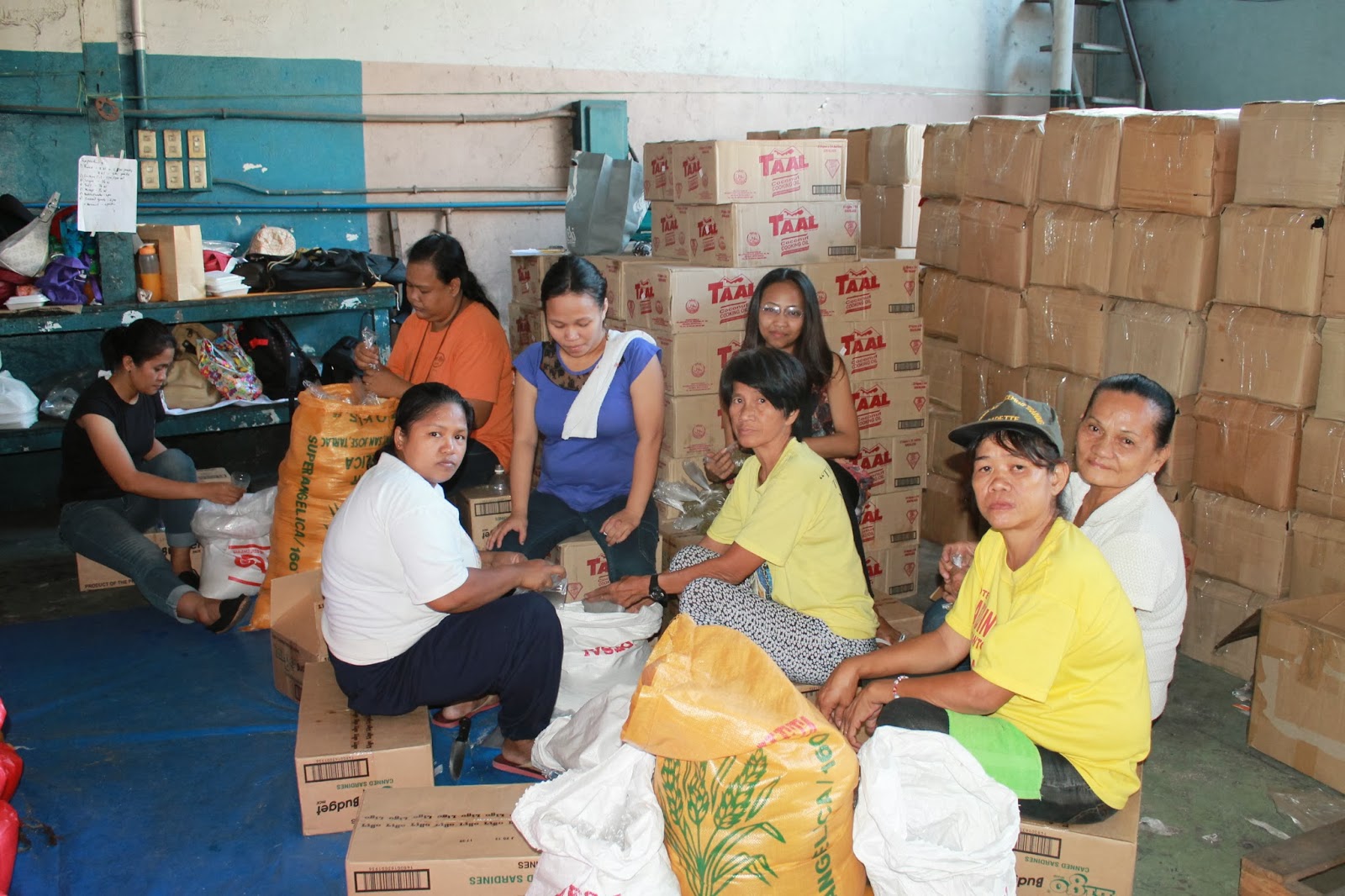
Community volunteers from Quezon City, Philippines.

Each blue bag holds a relief pack good for a family of 6 for 2-3 days.

Relief packs and water cans for the affected families in Samar.

Community Health Workers from Pasig join in solidarity by packing dried fish to be included in the relief packs.
Subscribe to:
Posts (Atom)

 Posts


